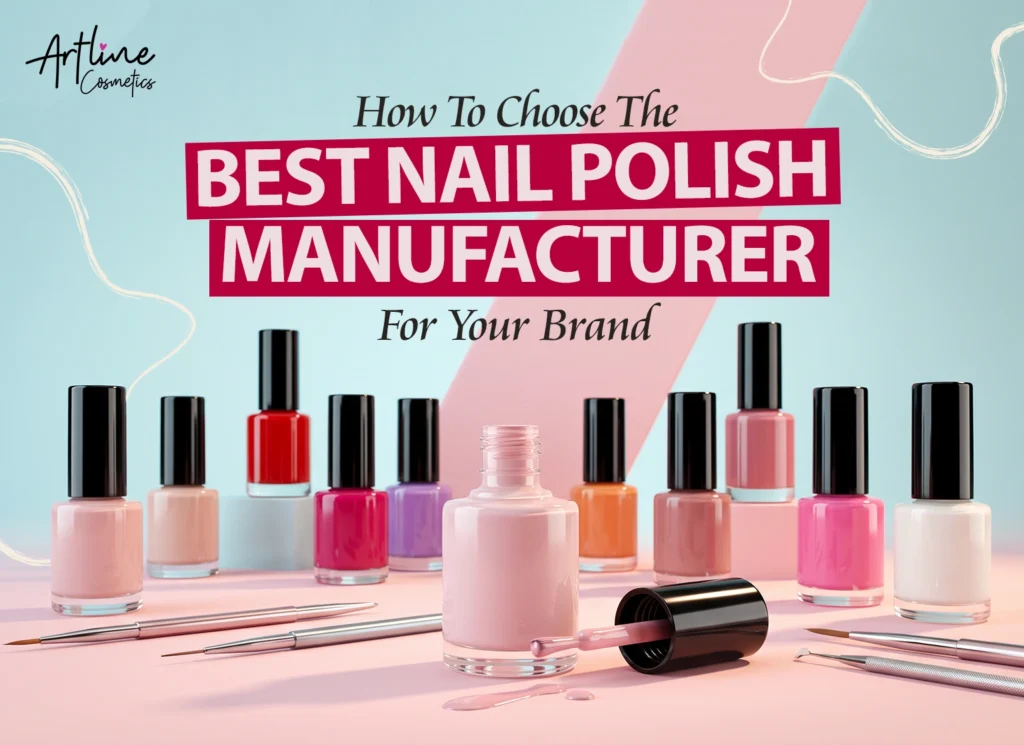
How To Choose The Best Nail Polish Manufacturer For Your Brand
Launching a nail polish brand involves more than selecting attractive shades and putting them into stylish bottles. The nail paint manufacturer you choose can influence formulation quality, color consistency, packaging, production capacity, compliance, and how easily your business can scale.
For a new or growing beauty brand, the right manufacturing partner should understand both the technical side of nail products and the commercial requirements of private-label cosmetics. Artline Cosmetics Private Limited provides private-label, contract manufacturing, custom formulation, and new product development services for nail-care brands, with options covering multiple finishes and product concepts.
1. Start With Manufacturing Experience
One of the first things to assess is the manufacturer’s experience with nail products specifically. Nail polish requires careful handling of formulations, pigments, solvents, packaging components, and filling processes.
An experienced nail polish manufacturer should be able to explain its formulation capabilities, testing procedures, available finishes, packaging options, and production process clearly.
Look for experience with products such as the following:
- Classic nail enamels
- Glitter and shimmer polishes
- Metallic finishes
- Matte formulas
- Gel-effect polishes
- Mirror-effect products
- High-gloss finishes
A broad product portfolio can also make it easier to expand your collection later without searching for another supplier.
2. Evaluate Formula And Colour Development
Color is one of the most important parts of a nail product. Customers expect the shade shown on the packaging or promotional material to closely represent what they see on their nails.
Ask potential manufacturers whether they offer custom shade development, color matching, formula adjustments, and sample approval before production.
A reliable Nail paint manufacturer should have a clear process for developing and approving samples. This allows your team to assess pigmentation, application, finish, drying characteristics, and overall appearance before committing to a larger production run.
Customization can also help your brand create signature colors instead of relying entirely on generic shades already available in the market.
3. Check The Manufacturer’s Quality Control
Quality consistency becomes increasingly important as your order volume grows. A shade that performs well in one batch but differs noticeably in another can affect customer trust.
Ask manufacturers about their quality checks for raw materials, color, viscosity, filling, packaging, and finished products. Also find out whether samples are retained for batch comparison and what happens when a batch does not meet the required specifications.
According to Artline’s published information, its nail-care manufacturing process focuses on color consistency, viscosity, durability, safety, and quality checks.
Rather than accepting broad claims about quality, ask for specific information about the manufacturer’s testing and quality-assurance procedures.
4. Verify Regulatory And Safety Requirements
Compliance should be considered before production begins, particularly when you are developing cosmetics for commercial sale.
India’s Cosmetics Rules, 2020, contain specific provisions relating to cosmetics manufacturing. The rules also include requirements specifically covering nail polishes and nail lacquers, including suitable equipment, premises, storage, and safety provisions.
The rules also reference Indian Standard IS 9245 for nail polish or nail enamel among the standards listed for finished cosmetics.
Therefore, when comparing nail polish manufacturers in India, ask about applicable manufacturing licenses, product documentation, quality standards, labeling requirements, and the compliance support they provide.
5. Compare MOQ With Your Business Stage
Minimum order quantity can have a significant effect on your initial investment.
A startup launching its first collection may want to test a limited number of shades before placing larger orders. An established retailer may require much higher volumes from the beginning.
Before signing an agreement, clarify:
- MOQ per shade or SKU
- Packaging minimums
- Custom formulation minimums
- Sample costs
- Repeat-order requirements
- Production capacity
- Lead times
The ideal partner should be able to accommodate your current requirements while having enough capacity to support future growth.
6. Look At Packaging And Branding Flexibility
Nail polish packaging contributes directly to how a product looks on a retail shelf or online store. Bottle shape, brush, cap, label, color presentation, and outer packaging can all influence brand perception.
Ask whether the nail paint manufacturer can provide standard packaging as well as customized options. It is also useful to know whether formulation, filling, labeling, and packaging can be managed through the same partner.
Artline states that its private-label services include formulation, color development, packaging, labeling, compliance support, production, and delivery.
This type of integrated process can reduce the coordination required between multiple vendors.
A Simple Manufacturer Comparison Checklist
| Factor | What to Check | Why It Matters |
| Formulation | Custom and ready formulations | Helps meet your product concept |
| Shades | Custom colour development | Creates a distinctive collection |
| Finishes | Matte, glitter, gel, metallic, etc. | Supports product variety |
| Testing | Quality and stability checks | Improves consistency |
| MOQ | Minimum quantity per product | Controls inventory investment |
| Packaging | Bottle, brush, cap and labels | Supports brand identity |
| Compliance | Licenses and documentation | Helps meet regulatory requirements |
| Capacity | Ability to increase production | Supports business growth |
| Lead time | Sampling and production schedule | Helps plan launches |
7. Understand Private-Label Capabilities
Private-label manufacturing can help brands launch products without establishing their own manufacturing facility. However, the level of support differs between suppliers.
Some manufacturers primarily provide existing formulas with branding, while others offer custom formulations, color development, packaging, and product-development assistance.
Businesses researching top private-label manufacturing in India should therefore ask what is actually included in the service. A manufacturer offering extensive customization can be more useful if you want to develop a distinctive collection.
For example, Artline states that it works with both emerging and established brands and offers private-label nail products with formulation, packaging, and production support.
8. Don’t Skip The Sampling Stage
Before placing a large order, request samples and test them properly.
Instead of checking only the color, assess the complete user experience. Look at how smoothly the polish applies, whether the brush distributes the product evenly, how the finish appears after drying, whether the packaging feels appropriate, and whether the shade matches your approved reference.
If you are comparing the best nail polish manufacturers, sample testing can provide more useful information than a manufacturer’s product catalog alone.
It is also worth testing samples under realistic storage and usage conditions where appropriate. This can help identify issues before they affect a larger production batch.
9. Think Beyond Your First Collection
A manufacturing partner should ideally be able to support your brand as it develops.
You may start with a small collection of classic colors and later introduce seasonal shades, specialized finishes, or other nail-care products. A supplier with R&D and product-development capabilities can make these expansions easier.
Artline’s published company information highlights dedicated R&D capabilities, custom formulation, new product development, private label, and contract manufacturing.
This is particularly relevant for brands that want a long-term manufacturing relationship instead of sourcing every new product from a different supplier.
Questions To Ask Before Finalising A Manufacturer
Before signing an agreement, discuss the complete manufacturing process. Ask about formulation ownership, sample revisions, MOQs, packaging sourcing, testing, documentation, payment terms, lead times, shipping, and procedures for handling quality concerns.
You should also clarify whether the quoted price includes packaging, filling, labeling, testing, and other services. Comparing quotations on the same basis makes it much easier to identify the genuinely suitable option.
Summary
Choosing a manufacturing partner is ultimately about finding the right balance between product quality, customization, compliance, production capacity, cost, and reliability. Businesses searching for top private-label manufacturing in India should evaluate potential suppliers against their current requirements while also considering how well they can support future expansion.
A manufacturer with dedicated nail-care expertise, flexible product development, transparent processes, and appropriate quality controls can make launching and scaling a collection considerably more manageable. Artline Cosmetics Private Limited combines private-label and contract manufacturing with custom formulation and nail-care product development, giving beauty brands a range of options to consider when planning their next collection.
FAQs:
1. What should I check before choosing a nail polish manufacturer?
Look at formulation capabilities, quality control, product range, customization, MOQ, packaging options, regulatory compliance, production capacity, and delivery timelines.
2. Can a manufacturer create custom nail polish shades?
Yes, some manufacturers offer color development and matching services. Always request samples and approve the final shade before beginning bulk production.
3. Is private-label manufacturing suitable for new beauty brands?
It can be. Private-label manufacturing allows a brand to launch products under its own identity without establishing its own production facility. The level of customization varies between manufacturers.
4. Why is MOQ important when choosing a manufacturer?
MOQ determines how much inventory you need to purchase at one time. A lower MOQ can be useful for startups testing new products, while larger brands may require higher production volumes.
5. What makes a good nail polish manufacturing partner?
A suitable partner should combine reliable formulation and production capabilities with quality control, regulatory awareness, customization options, transparent communication, and the capacity to support your brand as it grows.